Length 13m (≈43 ft) · 1,200-hp turboprop engine
Operational radius 500㎞ (≈311 mi) · Top speed about 360㎞/h (≈224 mph)
Captures high-resolution imagery of targets 100㎞ (≈62.1 mi) away
Equipped to carry the air-to-ground missile "Cheongeom" and configurable as an attack drone
Operational radius 500㎞ (≈311 mi) · Top speed about 360㎞/h (≈224 mph)
Captures high-resolution imagery of targets 100㎞ (≈62.1 mi) away
Equipped to carry the air-to-ground missile "Cheongeom" and configurable as an attack drone
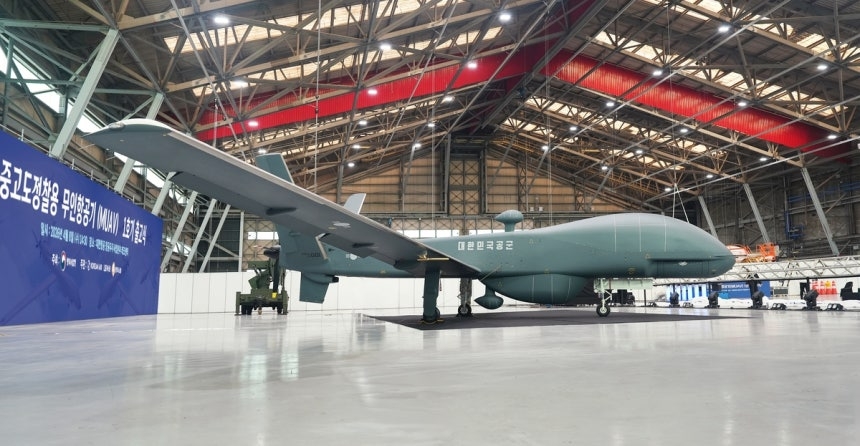 On April 8, South Korea unveiled its medium-altitude reconnaissance unmanned aerial vehicle (MUAV), widely dubbed the "Korean Reaper." The Defense Acquisition Program Administration held a rollout ceremony at Korean Air's Tech Center in Busan. Developed under the direction of DAPA and the Agency for Defense Development (ADD), with Korean Air, LIG D&A and Hanwha Systems participating, the MUAV is the country's first strategic-class unmanned aircraft.
 The program began after the United States declined to sell the RQ-4 Global Hawk in 2008, prompting the ADD to launch a domestic effort to develop a comparable reconnaissance platform. The program earned a combat-suitability designation in March 2022 and completed defense standardization. The first production MUAV emerged in 2026 after an extended development and testing process that drew international attention.
Ukrainian outlet Defense Express noted that large, multipurpose UAVs that once seemed marginal are regaining relevance. It added that South Korea went further by integrating not only optical systems but also synthetic aperture radar (SAR) for both reconnaissance and strike roles, producing a platform significantly smaller than the U.S. MQ-9 Reaper — a notable engineering achievement.
What does the Korean Reaper bring to the battlefield? The MUAV is 13m long with a 26m wingspan and is powered by a 1,200-hp turboprop, giving it robust propulsion. It can conduct reconnaissance from altitudes between 10–12㎞ (≈6.2–7.5 mi). Its radar and sensor suite can capture high-resolution imagery of targets at ranges up to 100㎞ (≈62.1 mi), a capability expected to materially enhance the ROK military's surveillance and targeting picture.
The system's defining feature is integration. Ground control, datalinks, advanced sensors and avionics have been fused into a single coordinated operating system. DAPA says that, once fielded, the MUAV will be able to monitor and respond to strategic targets in near real time using high-performance cameras and sensors.
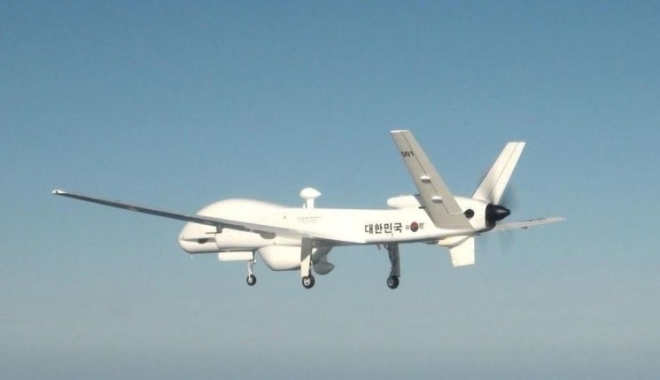 The production MUAV reaches roughly 90% domestic content by localizing major components and equipment. Korean Air led system integration, combining key subsystems developed by LIG D&A and Hanwha Systems. The designated operating unit will run system-integration and flight trials in July. After completing verification, DAPA plans to deliver the MUAV to the Air Force early next year, when it will begin operational surveillance and reconnaissance missions.
 The aircraft is large, weighing roughly 5,700㎏ (≈12,566 lb). It has an operational radius of 500㎞ (≈311 mi) and a top speed near 360㎞/h (≈224 mph). Its primary mission is precise ground-target reconnaissance from above 10㎞ (≈6.2 mi), delivering real-time imagery of strategic targets. To enable that mission, the MUAV carries a high-resolution SAR and electro-optical/infrared (EO/IR) cameras.
SAR enables operation in all visibility conditions and provides capability against hostile drones. With planned long-endurance sorties, the platform should give commanders faster, more precise operational and command options. Defense Express argued that it was logical for the Republic of Korea Air Force to order 10 of the systems.
The Army has operated the corps-level RQ-101 "Songgolmae" reconnaissance UAV since 2002, but its limited range constrained broad-area surveillance. That shortfall drove development of a longer-range MUAV, designated the RQ-105K.
Once operational, the MUAV will join reconnaissance satellites and high-altitude platforms such as the RQ-4 Global Hawk in forming the backbone of North Korea surveillance. It also appears well-suited to counter other unmanned systems: military officials say they plan to weaponize the MUAV with the domestically produced air-to-ground missile "Cheongeom," enabling unmanned strike missions.

- Home prices in the "Shesse-gwon" area move with Samsung and SK Hynix bonuses — local housing heats up [Housing Guide]
- Surpassing Samsung again — SK and TSMC deepen HBM4 partnership
- Used to buy it because it was cheap — now it looks like premium beef? Americans surprised by U.S. beef price lists
- Starlink outage halts U.S. Navy operations — is this a new challenge for SpaceX?
- Stock surges sweep top investors — one name outpaced SK Hynix
- Retail investors piled in during the rally, borrowing to buy — 23 trillion KRW (≈USD 17.25 billion) moved into KOSPI
- Even with a 76㎞ (≈47.2 mi) transfer, it costs about two cups of coffee — riders praise K-transfer
- "I'll win first in the relay and be right back" — why a healthy 30-something suffered an acute brain hemorrhage [Health]
- If I hide my college degree in my application, will they catch it? With a projected bonus of 700 million KRW (≈USD 525,000), applicants ask whether to claim only a high-school diploma
- Samsung Electronics union says even 40 trillion KRW (≈USD 30 billion) in bonuses wouldn't be enough