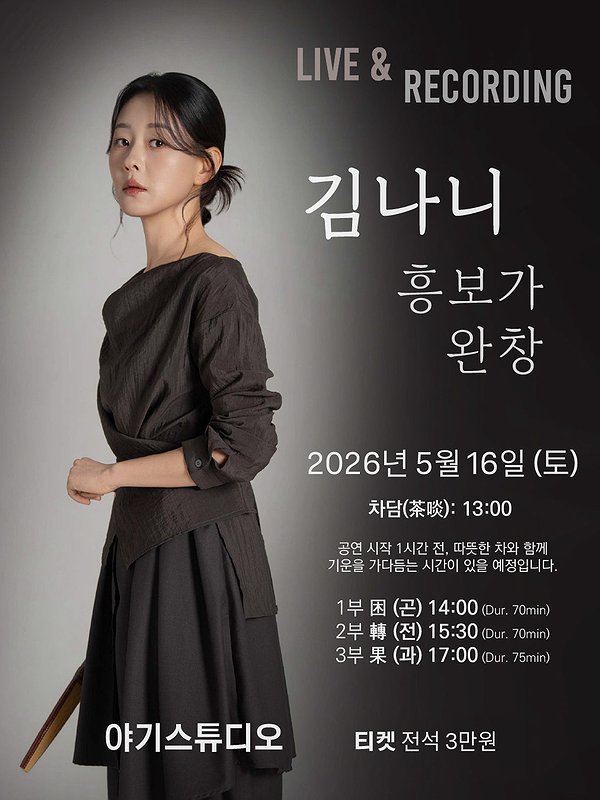
Pansori performer Kim Na-ni will revisit the Dongcho-style Heungboga she has championed for two decades in a live recording session.
Kim is more than a presence on television and concert stages; she has preserved the sound her teacher passed down over many years. For her, Heungboga has been a long-running personal project. She first learned the Dongcho-style Heungboga from Kim Se-mi twenty years ago. A brief note she wrote as an 18-year-old pansori student—“2006. 1. 3 Finished”—prompted her to look back on that period.
Over those two decades, Kim Na-ni the person and Kim Na-ni the performer evolved. Early on, her focus was on technical excellence and stamina; she pushed herself to become stronger. Over time she realized that that effort to harden herself had become limiting. Preparing for the recording turned into a process of releasing force and allowing the material to breathe.
That shift gives this complete Heungboga a distinctly personal cast. Kim began determined to perform the work successfully but gradually moved toward accepting herself as she is. The themes in Heungboga—poverty and desire, kindness and greed, punishment and realization—resonate with moments from her own life. At its center is, ultimately, “Kim Na-ni’s Heungboga.”
She previously presented “Kim Na-ni’s Complete Dongcho-style Heungboga” in 2014, performed a complete Dongcho-style Simcheongga in 2023, and staged another full Dongcho-style Heungboga in 2024.
Dongcho-style Heungboga stems from a pansori tradition that master singer Kim Yeon-su reorganized in the 1930s, blending several performance strands with his own interpretive choices. Dongcho emphasizes text and literary form: performers rely on precise diction, subtle gestures, and varied rhythmic phrasing to shape the story’s pacing and emotional trajectory.
Heungboga follows two brothers: the poor, kind-hearted Heungbo and his avaricious brother Nolbo. Beyond the well-known gourd-splitting episode, later sections of the Dongcho version introduce funeral workers, traveling performers, itinerant entertainers, and wandering beggars. Across its long, layered narrative, the work unfolds a moral economy of reward and punishment.
Kim Na-ni performs the full work rather than condensing Heungboga into a handful of famous scenes. She commits to the narrative’s full arc: Nolbo drives Heungbo from home; Heungbo finds a new life after splitting the gourd; and Nolbo collapses under the weight of his own greed.
The program is organized in three parts—Gon (Hardship), Jeon (Transformation), and Gwa (Result). Gon deals with poverty and suffering, Jeon marks Heungbo’s turning point, and Gwa explores the consequences of desire and the process of realization.
Gon opens with Nolbo expelling Heungbo from the household. Heungbo endures hunger and humiliation, without food or support. Seeking a brother’s compassion, he visits Nolbo, only to face contempt and violence. The section closes with the arrival of a monk who offers the possibility of change.
Kim resists turning Heungbo’s suffering into mawkish sentiment. Instead, she follows the narration’s rhythm and the characters’ emotions, sustaining the weight of hardship through extended vocal lines.

Jeon charts Heungbo’s transformation, beginning when he heals a swallow’s injured leg. The bird returns to repay that kindness. The narrative follows the swallow’s journey and the planting of gourd seeds that open new possibilities for Heungbo’s household.
The first and second gourds yield rice, money, and silk, lifting the family out of poverty. The third produces Yang Guifei figures and crowds, turning an empty home into a lively scene. Sorrow and resentment give way to surprise and joy. In the gourd-splitting passages, Kim emphasizes humor, elasticity, and rhythmic quickness in her singing.
In Gwa, Nolbo learns of Heungbo’s good fortune and returns home with gourd seeds after deliberately breaking a swallow’s leg to force the same result. He receives the seeds, but when he splits the gourds, calamities unfold—gradually eroding his wealth instead of bringing prosperity.
Near the end, the character Jangbi confronts Nolbo with the consequences of his greed. That episode provides the clearest moral statement in Heungboga: beneath the comedy lies a caution about the limits of desire. Kim propels the performance to its close by shifting between greed, absurdity, humor, and tension.
Kim Na-ni completed undergraduate and graduate studies in pansori performance at the School of Korean Traditional Arts, Korea National University of Arts, and is currently pursuing a doctorate in Korean music at Dongguk University. She won first prize in the vocal division at the 25th Jeonju Daesaseup Student Competition in 2007 and first prize in the general vocal division at the 7th Sugung National Gugak Competition in 2014.
Percussion accompaniment will be provided by Hwang Min-wang and Jo Han-min. In a full Heungboga, the drum governs the narrative’s breathing—shaping long passages and intensifying emotional movement in faster scenes. Together with Kim’s voice, the rhythmic support builds both the comic and tragic dimensions of the work.
Kim Na-ni will present and record the complete Heungboga live on May 16 at Agi Studio in Gangnam, Seoul, before a limited audience.
Reported by News Culture M.J. (mj94070777@nc.press)