The music of Czech Romantic composer Antonín Dvořák will fill the Aram Music Hall at Goyang Aram Nuri in a program built around two of his most enduring orchestral works.
The Goyang Philharmonic Orchestra will present its 52nd subscription concert, “Masterpieces by Dvořák,” at 7:30 p.m. on June 12 at the Aram Music Hall in Goyang Aram Nuri.
The first half features cellist Moon Taeguk in Dvořák’s Cello Concerto in B minor, Op. 104; the second half presents the composer’s iconic Symphony No. 9 in E minor, Op. 95, “From the New World.”
A leading voice of Romantic nationalism, Dvořák braided Bohemian folk idioms, lyrical warmth and rich orchestral color into works that remain central to the international symphonic canon. His music often carries both a yearning for home and impressions of unfamiliar places, particularly from his years in the United States.
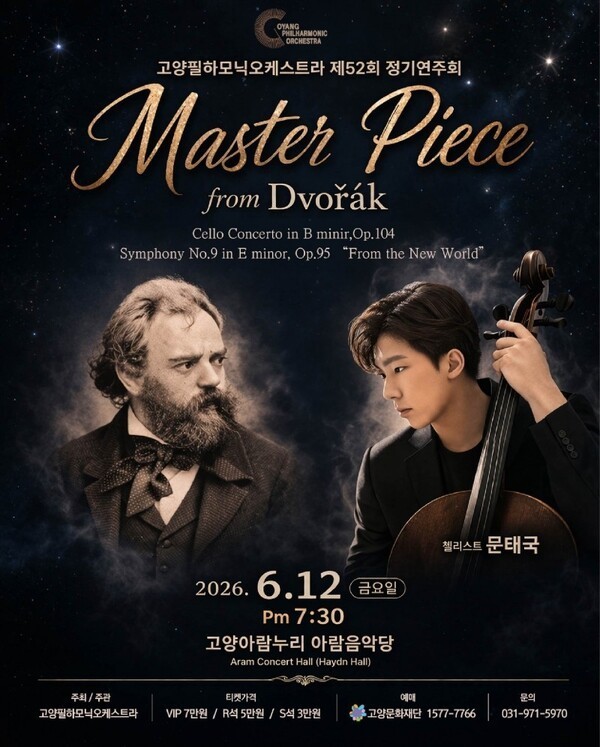
The program pairs Dvořák’s intimate lyricism with his monumental orchestral language. The Cello Concerto foregrounds the conversation between soloist and orchestra, driven by sweeping melodies and dramatic momentum. “From the New World” unfolds on a symphonic scale with instantly recognizable themes and broad emotional sweep.
The concert will be led by conductor Ahn Hyun-sung, who studied under H. D. Boltz at the State University of Music Trossingen in Germany before continuing his training at conservatories in Opava and Brno in the Czech Republic.
Ahn has conducted ensembles including the Jeonju Symphony Orchestra, Mokpo Symphony Orchestra, Opava Municipal Orchestra, National Symphony Orchestra of Ukraine, Janáček Chamber Orchestra, Uzbekistan National Symphony Orchestra, and the Ho Chi Minh City Orchestra. He currently serves as music director and principal conductor of the Goyang Philharmonic Orchestra.
Known for balancing standard symphonic repertoire with audience-friendly programming, Ahn has worked to deepen ties between regional listeners and large-scale orchestral music. For this concert he shapes the folk-derived melodies, dense string textures, and the coloristic interplay of brass and woodwinds that define Dvořák’s sound world.
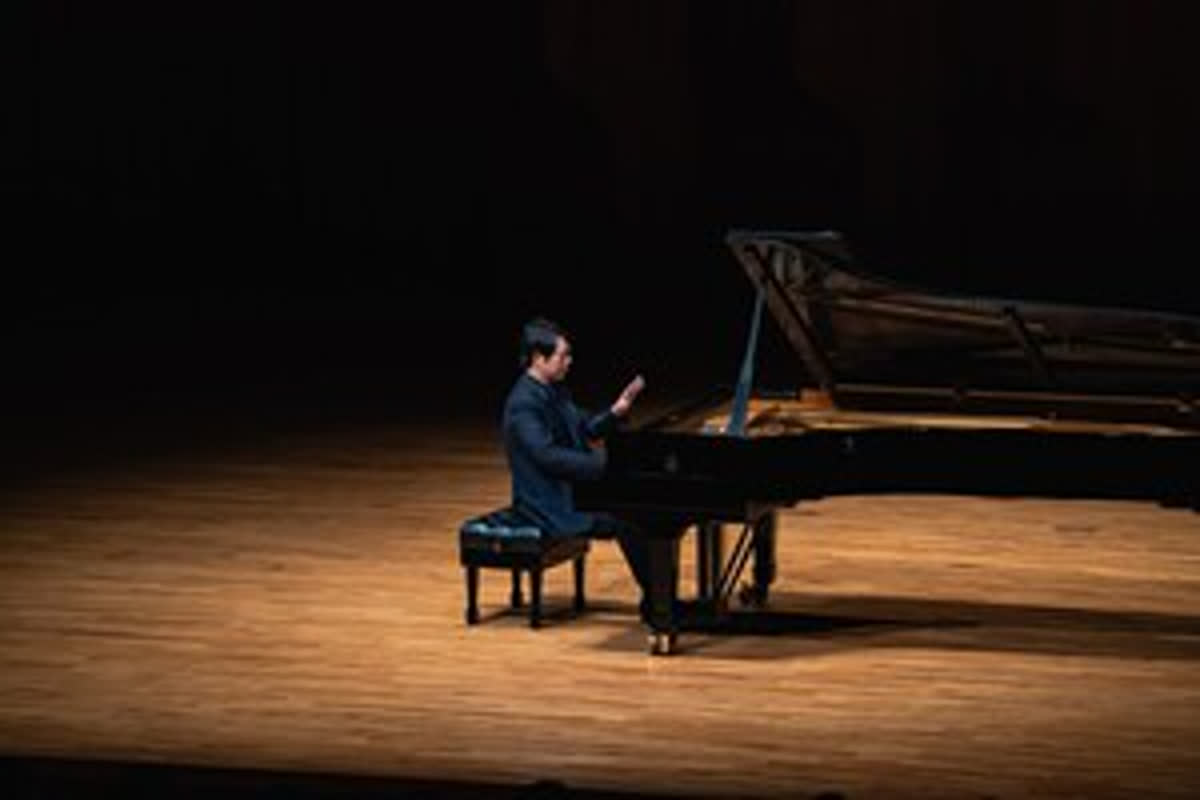
Soloist Moon Taeguk has built a distinguished international career through major competition wins and high-profile appearances. He won first prize at the André Navarra International Cello Competition in 2011 and at the Pablo Casals International Cello Competition in 2014, where he also received the inaugural János Starker Award. His Pablo Casals victory was the first time an Asian musician took the top prize in the competition’s history.
He later served as artist-in-residence at Kumho Art Hall in 2017 and as an in-house artist at Lotte Concert Hall in 2022.
Praised for a rich tone and restrained but emotionally rooted interpretations, Moon has continually explored the central works of the cello repertoire. Dvořák’s concerto—often ranked among the greatest for the instrument—demands both technical command and sustained lyrical depth from its soloist.
Composed during Dvořák’s time in the United States, the concerto opens with a potent orchestral introduction before the cello enters with broad, singing lines. The solo part relies not simply on virtuosity but on long-breathed phrasing and inward resonance to carry the work’s emotional architecture.
The second movement moves with Dvořák’s characteristic warmth and lyricism: the cello builds tension in its lower register while the orchestra colors the surrounding atmosphere. The finale alternates dance-like vigor and reflective nostalgia before reaching a grand conclusion tinged with quiet longing for home.
The second half’s Symphony No. 9, “From the New World,” captures Dvořák’s impressions of America while remaining deeply rooted in Bohemian sensibility. The work fuses memories of home, imagined folk melodies and the emotional sweep of the symphonic tradition into one of his most celebrated scores.
The opening movement sustains tension and anticipation through dark orchestral textures and forceful thematic statements. The famous second movement begins with an English horn melody that has come to symbolize homesickness and remembrance, offering one of the orchestra repertoire’s most lyrical passages.
The scherzo moves with rhythmic propulsion that recalls folk-dance traditions, while the finale channels the symphony’s thematic energy into a sweeping close, with brass, strings and woodwinds engaged in dramatic exchange.
Founded in 1999, the Goyang Philharmonic Orchestra has cultivated the region’s classical-music scene through regular concerts, collaborations and community-centered programming. The ensemble pursues both core symphonic repertoire and accessible programming designed to broaden classical music’s audience in Goyang.
The orchestra said the performance aims to “share the profound human emotions and timeless messages in Dvořák’s music,” adding that audiences can expect “an evening full of deep resonance and emotional depth.”
News Culture report by M.J._mj94070777@nc.press