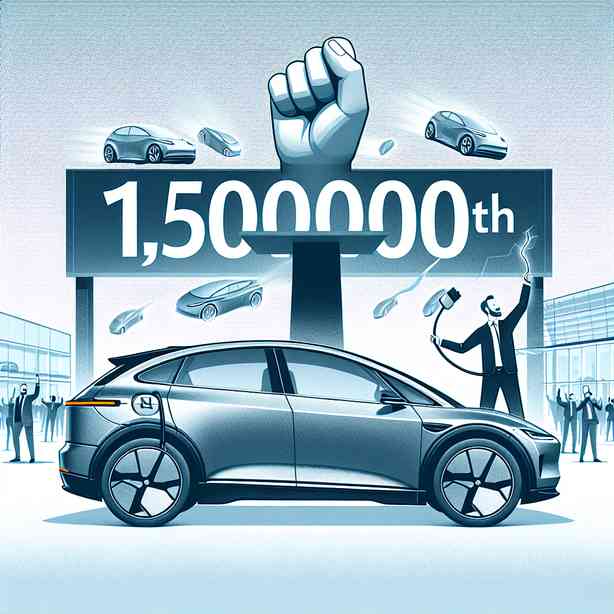
Volkswagen names its 1.5 millionth electric-vehicle buyer
Volkswagen has emerged as a standout in the global EV market through steady innovation and disciplined growth. Its announcement that it has identified its 1.5 millionth electric-vehicle buyer has drawn attention across the industry and among consumers. The milestone reinforces Volkswagen’s reputation as an EV innovator and strengthens its market position. More than a sales figure, it highlights the company’s influence as the auto industry pivots toward electrification.
Volkswagen’s journey to EV leadership
Once a predominantly internal-combustion automaker, Volkswagen has rapidly transformed into a mobility company centered on electrification. Built around the ID. family—ID.3, ID.4, ID.5 and ID. Buzz—the lineup has helped position VW at the forefront of EV development. SUV models such as the ID.4 have seen steady global sales growth and built strong consumer trust. Volkswagen’s EV strategy extends beyond new models to advances in battery chemistry, charging infrastructure and vehicle software.
What the 1.5 millionth buyer signifies
Naming its 1.5 millionth EV buyer signals that electric vehicles have moved into the mainstream. Consumers increasingly cite environmental concerns alongside lower operating costs and competitive on-road performance when choosing EVs. Reaching this milestone validates Volkswagen’s role as a market mover and reinforces consumer confidence in the company’s global electrification push.
Volkswagen’s competitive edge in the global EV market
The global EV market is expanding rapidly, driven by stricter emissions rules and government incentives. In this landscape, Volkswagen competes at scale: selling hundreds of thousands of EVs annually and standing alongside leading names such as Tesla. VW’s market share has risen in core regions including Europe, China and North America. Its mass-production capabilities reduce unit costs and allow the company to offer EVs across multiple price tiers, broadening consumer choice—an approach central to Volkswagen’s rise as an EV leader.
Technological innovation behind Volkswagen’s EVs
Volkswagen’s EV advances rest on solid engineering. The in-house MEB (Modularer E-Antriebs-Baukasten) platform boosts production efficiency and scalability by integrating the battery into the vehicle floor, lowering the center of gravity and maximizing interior space. VW also deploys over-the-air (OTA) updates to continually refine vehicle performance and user experience. Advances in higher-energy-density battery cells have extended single-charge range. Across development and deployment, Volkswagen remains a technical leader in EV engineering.
Sustainable production and green management
Volkswagen pursues sustainability across its operations, not just in vehicle assembly. The company uses 100% renewable energy in EV production and works to minimize CO2 emissions from manufacturing. VW is scaling battery-recycling initiatives to build a circular supply chain, commercializing material recovery to help stabilize long-term raw-material supply and reduce environmental impact. These practices strengthen the company’s green credentials.
Buyer experience and service innovation
Volkswagen has introduced a range of customer-facing innovations to simplify EV ownership: contactless online purchasing, digital showrooms and dedicated concierge services make buying easier. The company has expanded EV-focused service networks and boosted technician training to improve maintenance reliability. Volkswagen is also rolling out high-power charging infrastructure across Europe, North America and China. These service and retail changes support VW’s leadership position in the EV market.
Future strategy as an EV icon
Volkswagen plans to deepen its role in electrification through several strategic moves. The company aims to convert a significant share of new-vehicle sales to battery-electric models in the coming years while advancing EV-dedicated platforms and next-generation battery technology. Volkswagen is also investing in autonomy and connected services, seeking to integrate EVs with self-driving and connected features to help shape the future of mobility. These initiatives lay the groundwork for continued growth.
Social responsibility and ripple effects across the global market
As Volkswagen scales its EV business, it accelerates the global shift toward cleaner mobility. Broader adoption of VW’s EVs raises overall clean-vehicle penetration and its large-scale production and supply-chain changes send ripple effects through suppliers and the wider automotive ecosystem—creating jobs and spurring R&D investment that boost local economies. Volkswagen also collaborates with governments and municipalities to expand sustainable transport infrastructure, reinforcing its social responsibility. In this way, the company’s EV push generates positive change across the industry and society.
Volkswagen’s ongoing evolution as an EV icon
True to its EV-icon status, Volkswagen continues to evolve across products, technology, services and corporate practices. Reaching the 1.5 millionth buyer is more than a milestone—it underscores Volkswagen’s central role in the global clean-mobility market. With new models, advanced technologies and sustainable practices on the horizon, Volkswagen appears positioned to remain a leading force in the EV transition.