■ Record number of port calls planned this year
Rise in visits from China pushes total to 132 calls
Strengthening status as Northeast Asia’s leading port of call
Routes will likely shift back if China-Japan thaws
Must build self-sustaining appeal with specialty content
Rise in visits from China pushes total to 132 calls
Strengthening status as Northeast Asia’s leading port of call
Routes will likely shift back if China-Japan thaws
Must build self-sustaining appeal with specialty content
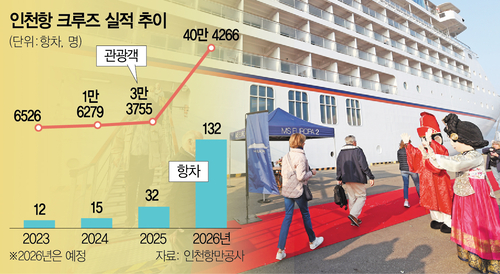
On the 15th, Incheon City and the IPA announced they expect a record year: 132 cruise calls and about 400,000 passengers. That’s a dramatic jump from three years ago, when the port recorded just 12 calls and 6,526 passengers—roughly 11 times and 62 times higher now, respectively. The number of calls tops the previous high of 95 in 2013 by 39%, and passenger totals more than double the 184,000 seen in 2014.
The IPA has confirmed 404,266 cruise passengers this year. Of 410,459 available berths, only 1.5% are empty. Add roughly 129,000 crew members, and more than 530,000 people will pass through Incheon Port this year—meaning a city of 3 million will host well over half a million cruise visitors and crew.
If last year was about laying groundwork, 2026 is about growth and payoff. Incheon City and the IPA will sharpen three pillars—attraction, content, and infrastructure—to match the surge in cruise traffic.
First, attraction efforts will scale up with government participation. The Shanghai port-sales event, previously run by Incheon City and the IPA, will become a joint event led by the Ministry of Oceans and Fisheries and broaden its targets to include Japan and Europe. Incheon will also set up booths at major international gatherings—Seatrade Cruise Global (U.S.), the Jeju International Cruise Expo, and the Shanghai International Cruise Summit—to deepen global connections.
Port-of-call programming will split into group and independent options to boost quality. For group tours, fam trips will emphasize hands-on experiences—local breweries, crafts, and wellness—and expand visits to underused areas like Ganghwa and Yeongjong. For solo travelers and small parties, terminals will have multilingual staff and new walking routes in the Sinpo and Songdo districts. Starting in June, Incheon will run a cruise coupon event in Songdo and the open-port commercial district, and it’s exploring tie-ins with local festivals such as the Jajangmyeon (black-bean noodle) Festival to drive tourism.
A new send-off program debuts this year, too. For major departures, the port will stage local cultural performances on the pier—taking cues from Yokohama’s yellow handkerchief send-offs and Kanazawa’s traditional instrument shows. It follows the idea that your last impression often decides whether you’ll return.
Passenger services will get a serious upgrade. Free shuttle buses will run flexibly based on ship size and will link Songdo and Sinpo routes. The city will add dedicated porters for baggage handling and improve terminal signage. City tours will see double-decker buses deployed in numbers that match cruise capacity.
This set of initiatives is the first-year rollout of the Second Five-Year Cruise Industry Development Plan (2026–2030). An IPA official said, “Our ultimate goal is to move beyond dependence on China-origin routes and make Incheon itself a cruise destination. Once send-off programs and port content take root, cruise lines will see Incheon as an indispensable regular port of call.”
Still, structural risks remain. With more than 80% of this year’s calls coming from China, routes could revert to Japan if Sino-Japanese ties thaw. An industry source suggested building reasons why cruises must stop in Incheon—through memorable send-offs and hands-on experiences—and growing homeport operations and trans-Pacific routes to diversify the port portfolio so Incheon can stand on its own as a hub.