
In 2025, the imperative for local news organizations was clear: diversify revenue. Four years earlier, many regional broadcasters weathered a shrinking broadcast-ad market with layoffs and building sales. Now they are actively reshaping how they make money. Beyond reporting, stations have pursued rental income, DOOH screens, solar power, marathons and golf tournaments, and YouTube channels to broaden their revenue base.
Among regional MBC stations, only Mokpo MBC posted a profit. Private regional broadcasters, which were healthier four years ago, also flipped: just three of ten were profitable this year. Still, newsrooms and executives are busier than ever. MediaToday analyzed three years of operating profit and revenue for 34 major local outlets—10 private broadcasters, 16 regional MBCs and eight regional newspapers—using filings from the Financial Supervisory Service and original reporting. For figures above 1 billion KRW (approximately 750,000 USD) we rounded to the nearest 10 million KRW (approximately 7,500 USD) and reported in 100 million KRW units (approximately 75,000 USD); amounts below 1 billion KRW are shown to the nearest 10 million KRW (approximately 7,500 USD).
All regional MBCs except Mokpo MBC posted operating losses. “Diversifying revenue is essential.”
Last year, only one of 16 regional MBCs generated operating profit: Mokpo MBC, which reported 330,000,000 KRW (approximately 247,500 USD) in operating profit. Every other regional MBC recorded losses: Daegu MBC (-9,800,000,000 KRW; approximately -7,350,000 USD), MBC Gyeongnam (-1,700,000,000 KRW; approximately -1,275,000 USD), Busan MBC (-16,500,000,000 KRW; approximately -12,375,000 USD), Yeosu MBC (-1,300,000,000 KRW; approximately -975,000 USD), Jeonju MBC (-550,000,000 KRW; approximately -412,500 USD), Gwangju MBC (-3,000,000,000 KRW; approximately -2,250,000 USD), Daejeon MBC (-340,000,000 KRW; approximately -255,000 USD), MBC Gangwon Yeongdong (-2,100,000,000 KRW; approximately -1,575,000 USD), Wonju MBC (-2,400,000,000 KRW; approximately -1,800,000 USD), Chuncheon MBC (-500,000,000 KRW; approximately -375,000 USD), Pohang MBC (-2,600,000,000 KRW; approximately -1,950,000 USD), MBC Chungbuk (-2,600,000,000 KRW; approximately -1,950,000 USD), Andong MBC (-3,900,000,000 KRW; approximately -2,925,000 USD), Ulsan MBC (-3,300,000,000 KRW; approximately -2,475,000 USD), and Jeju MBC (-2,600,000,000 KRW; approximately -1,950,000 USD).
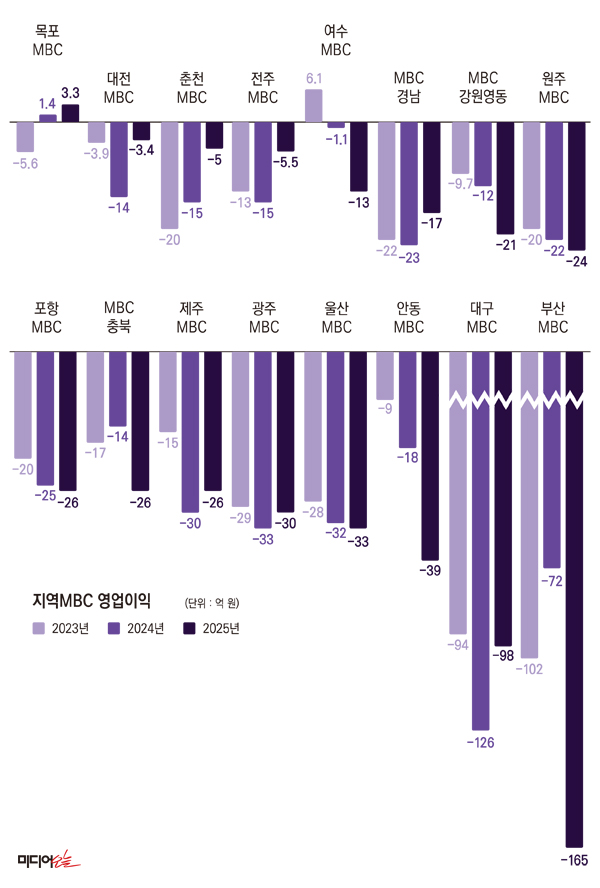
The picture for regional MBCs is bleak: 15 stations finished in the red. The chief culprit is a sharp decline in broadcast ad revenue. “KOBACO advertising drops by roughly 15%–20% a year,” said Lee Hae-seung, head of the Regional MBC Strategy Support Team. “Advertisers have shifted to OTT and digital platforms. Fewer viewers watch terrestrial TV, and advertisers find those spots less effective—so broadcast ad revenue has collapsed.”
To counter mounting deficits, stations must grow non-broadcast income. Many already have: solar farms, bakeries, restaurants and other ventures. Mokpo MBC, the lone profitable regional MBC last year, diversified early. After relocating near Mokpo Station in 2023, it began earning rental income and launched a DOOH business. It has also expanded an eight-year investment in solar power. Jeonju MBC has likewise leaned into solar projects, capitalizing on the wide plains of the Honam region.
Some broadcasters raised operating funds by selling real estate. Daegu MBC sold its building in 2019 for 400 billion KRW (approximately 300,000,000 USD), and Busan MBC sold its headquarters in 2021 for 360 billion KRW (approximately 270,000,000 USD).
Mokpo MBC CEO Kim Soon-gyu prefers the term “rebalancing revenue streams” rather than mere “diversification.” “Our media wall produces revenue others don’t have,” Kim said. “Moving near Mokpo Station created rental income, and we added DOOH. We’ve steadily expanded solar investments and pushed local sales. Operating profit isn’t down to a single factor.” Facing a collapse in broadcast ads, Mokpo MBC has reduced the share of KOBACO advertising in overall revenue; KOBACO now accounts for about 23% of company revenue. “Many companies still rely on KOBACO for more than half their revenue,” Kim added. “That dependency isn’t sustainable. Broadcast advertising keeps falling and, given the media landscape, it’s unlikely to recover.” (MBC advertising is handled by KOBACO.)
MBC Gyeongnam offers an example of investing in content to generate new income. Several high-quality documentaries found critical and popular success. “Adult Kim Jang-ha” (2023) and “Gimbap Heaven” (2024) became the first regional programs distributed on Netflix. Gyeongnam’s YouTube channels—“MKitaka” with 1.06 million subscribers and “MNew” with 470,000—have also expanded reach. While content investment rarely yields immediate profits, steady efforts now produce about 1,000,000,000 KRW (approximately 750,000 USD) in annual content revenue, which helped narrow losses and produced a net income of 40,000,000 KRW (approximately 30,000 USD) last year.

“Terrestrial stations are rooted in their regions, but the digital market opened new doors,” said MBC Gyeongnam CEO Lee Woo-hwan. “We adapted to YouTube and OTT. Even from a remote region, content that resonates can compete.” Lee said Netflix distribution made sponsorships and production funding easier, which helped chip away at accumulated deficits.
Lee acknowledged that traditional terrestrial models often meant more content production didn’t produce more profit. He persuaded staff to pursue supported projects—through the Korea Radio Promotion Association, Gyeongsangnam-do’s regional development fund and the Korea Broadcasting Culture Promotion Agency—so reporters and producers could build sustainable content businesses. “Now people say we’re a production company that can make a film every two years and run a digital channel with 1.5 million subscribers,” he said. “The aim is to reach a structure that reliably generates about 500,000,000 KRW (approximately 375,000 USD) to 1,000,000,000 KRW (approximately 750,000 USD) annually.”
Four years ago, only two of 10 private regional broadcasters ran deficits; now only three are profitable
Last year, only three of ten private regional broadcasters turned a profit: KNN, TBC and JTV. That’s a sharp reversal from 2021, when only two were in the red. KNN, TBC and JTV reported operating profits of 2,700,000,000 KRW (approximately 2,025,000 USD), 1,500,000,000 KRW (approximately 1,125,000 USD) and 1,300,000,000 KRW (approximately 975,000 USD), respectively. Loss-making stations included UBC (-2,000,000,000 KRW; approximately -1,500,000 USD), KBC (-3,900,000,000 KRW; approximately -2,925,000 USD), TJB (-1,800,000,000 KRW; approximately -1,350,000 USD), CJB (-1,700,000,000 KRW; approximately -1,275,000 USD), G1 (-230,000,000 KRW; approximately -172,500 USD), JIBS (-2,500,000,000 KRW; approximately -1,875,000 USD) and OBS GyeonginTV (-540,000,000 KRW; approximately -405,000 USD).
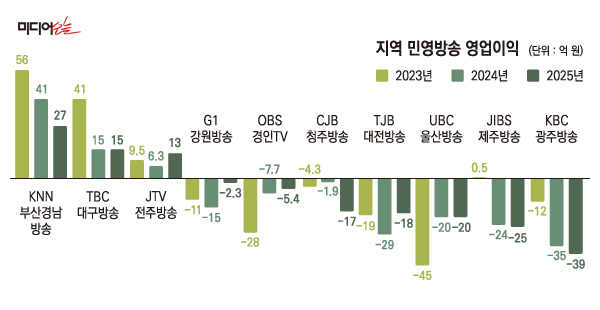
Falling ad revenue has hit private stations hard. “Stations that saw smaller drops in ad sales have managed; those hit harder haven’t,” said Kim Hyun-chul, secretary general of the Korea Association of Local Private Broadcasters. “Because ad sales are the main revenue source, there’s a limit to how much other businesses can compensate. That’s why many are pushing to ease advertising regulations.”
KNN, TBC and JTV have posted operating profits for three consecutive years, but their margins are shrinking. KNN’s operating profit dropped from 5,600,000,000 KRW (2023; approximately 4,200,000 USD) to 4,100,000,000 KRW (2024; approximately 3,075,000 USD) and 2,700,000,000 KRW (2025; approximately 2,025,000 USD). TBC’s profit fell from 4,100,000,000 KRW (2023; approximately 3,075,000 USD) to 1,500,000,000 KRW (2024; approximately 1,125,000 USD) and remained at that level in 2025. JTV dipped from 950,000,000 KRW (2023; approximately 712,500 USD) to 630,000,000 KRW (2024; approximately 472,500 USD), then rebounded to 1,300,000,000 KRW (2025; approximately 975,000 USD) last year.
A TBC representative said the pockets of profitability derive less from core broadcasting and more from events, bidding projects and other non-broadcast ventures. “Ad revenue alone no longer covers payroll,” the representative said. “Advertising is falling by about 10% a year. Ad income shrank from roughly 27 billion KRW in 2012 (approximately 20,250,000 USD) to about 7.3 billion KRW last year (approximately 5,475,000 USD).” They warned that the industry’s base is eroding while regulations remain unchanged, widening the gap between policy and reality.
Non-broadcast business diversification is now essential. Kim Chun-young, JTV’s communications director, said ad revenue plunged from roughly 18 billion KRW in the early 2000s (approximately 13,500,000 USD) to about 3.2 billion KRW recently (approximately 2,400,000 USD). “With an annual drop of about 20%, regional broadcasters can’t avoid deficits. Even when we reported profit, the amounts were small. To stay afloat, we explored new businesses and even planned and ran municipal festivals ourselves.”

Platforms like YouTube have provided a viable revenue stream for some. “YouTube became one of our business areas,” Kim said. “Last year YouTube revenue rose substantially; without it, we likely would have stayed in the red. Regional broadcasters are pursuing many paths to offset declining ad sales.”
Regional MBCs and private stations bundle ad sales with Seoul MBC (via KOBACO) and SBS, so declines at the national networks hit locals directly. “When ad volume was high, transmission-fee allocations alone kept regional stations in the black,” Lee Hae-seung said. “Since about 2017, many have fallen into the red. Employees didn’t join broadcasters to become business operators, but financial pressure has pushed them into commercial ventures. Sometimes it pays off; sometimes it causes losses.”
Gyeonggi Ilbo posts 1 billion-won profit; Busan Ilbo dramatically cuts losses—'Diversifying revenue remains key'
Regional newspapers are also pursuing new businesses to support their core journalism. Of eight major regional papers that disclosed 2025 results, two posted operating profits above 500,000,000 KRW (approximately 375,000 USD): Gyeonggi Ilbo and Jeonbuk Ilbo. Operating profits were Gyeonggi Ilbo 990,000,000 KRW (approximately 742,500 USD), Jeonbuk Ilbo 640,000,000 KRW (approximately 480,000 USD), Gangwon Domin Ilbo 140,000,000 KRW (approximately 105,000 USD) and Gangwon Ilbo 120,000,000 KRW (approximately 90,000 USD). Losses were posted by Busan Ilbo (-4,600,000,000 KRW; approximately -3,450,000 USD), Kookje Ilbo (-1,900,000,000 KRW; approximately -1,425,000 USD), Kyeongin Ilbo (-810,000,000 KRW; approximately -607,500 USD) and Yeongnam Ilbo (-470,000,000 KRW; approximately -352,500 USD).
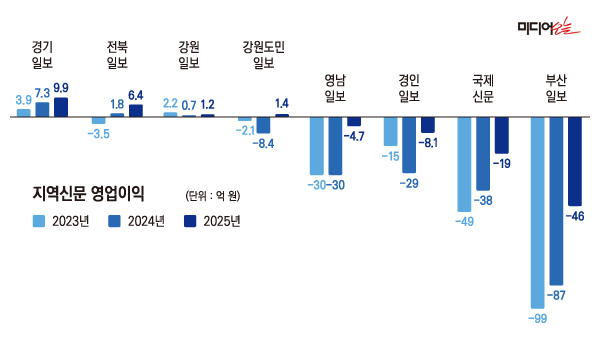
Busan Ilbo narrowed its loss to 4,600,000,000 KRW (approximately 3,450,000 USD) last year from -9,900,000,000 KRW (approximately -7,425,000 USD) in 2023. Revenue also rose to 38.6 billion KRW (approximately 28,950,000 USD), up from 32 billion KRW (approximately 24,000,000 USD) two years earlier. The paper credits a company-wide push to recover ad sales and management’s move into culture projects, a data center, leasing, outdoor advertising and an investment in a digital-asset exchange. Executives say they plan to reinvest diversified revenue into content.
Sohn Young-shin, who became CEO last February after serving as reporter, editor and director, said the company aims to return to profitability this year. “We cut costs, including through natural attrition, and everyone worked to grow ad and sponsorship revenue,” Sohn said. “New culture projects included the Yangsan Egg-ya Festa, a golf tournament and a digital finance and blockchain academy. We continue marine and fisheries CEO academy programs as well.”
Gyeonggi Ilbo stands out: revenue rose from 28 billion KRW (2023; approximately 21,000,000 USD) to 31.6 billion KRW (2024; approximately 23,700,000 USD) and 35.1 billion KRW (2025; approximately 26,325,000 USD). Operating profit climbed from 390,000,000 KRW (approximately 292,500 USD) to 730,000,000 KRW (approximately 547,500 USD) and then to 990,000,000 KRW (approximately 742,500 USD). The paper’s business director cited competitive bidding projects, sports events and museum-exhibition ventures. Gyeonggi Ilbo also became the only outlet in the Gyeonggi–Incheon area to join Naver’s Content Partner program in 2023, which brought syndication fees and wider exposure.
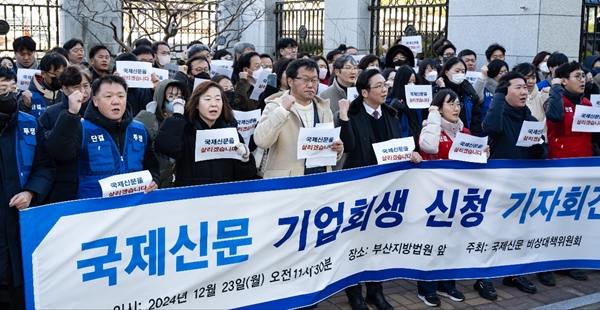
Ownership disputes have also affected some papers. Kookje Ilbo endured long-term deficits under its longtime owner and is now seeking a new majority shareholder. “When the owner launched a printing company in 2019, management troubles deepened,” said Ha Song-yi of the Korean Federation of Journalists’ Unions. “We had no time to plan long-term strategy. After joining Naver’s CP program, digital opportunities appeared, but staff cuts delayed them.”
Ha added that Kookje Ilbo was excluded from Regional Newspaper Development Fund support because of capital erosion. “The fund was meant to help struggling local papers, but when our situation worsened we couldn’t get support. We scored zero on management transparency and were disqualified,” she said.
Kyeongin Ilbo saw its major shareholder change twice in a year. Profitable through 2022, it recorded operating losses of -1,500,000,000 KRW in 2023 (approximately -1,125,000 USD), -2,900,000,000 KRW in 2024 (approximately -2,175,000 USD) and -810,000,000 KRW in 2025 (approximately -607,500 USD). After a new majority owner reduced debt and injected capital, losses fell to about one-third.
Shin Ji-young of the Kyeongin Ilbo union said staff declined from roughly 140–150 people to about 120, lowering costs, and that new shareholders injected about 5,000,000,000 KRW (approximately 3,750,000 USD) to reduce a roughly 7,000,000,000 KRW (approximately 5,250,000 USD) debt. “We expect to return to profit this year,” Shin said. “Our headquarters building generates rental income, and we run the Songdo Marathon and other cultural businesses. We’re exploring elevator ads and highway and Suwon Station billboards to diversify revenue.” She also urged municipalities to route ads through media foundations to reduce fees. “A 10% commission—charging 50,000 KRW (approximately 37.50 USD) on a 500,000 KRW (approximately 375.00 USD) ad—treats national and regional outlets the same, even though a national paper may have 300 billion KRW in revenue and a regional one 20 billion KRW. That should change.”
Policy support must align with the government’s “five poles, three specialties” plan
Calls for public support for local media surface every year, but implementation has lagged. Last year the Ministry of Economy and Finance cut a 20.7 billion KRW (approximately 15,525,000 USD) budget the National Assembly approved for strengthening content competitiveness at regional small-to-medium broadcasters down to about 5.5 billion KRW (approximately 4,125,000 USD). “Next year’s budget must restore baseline public funding so regional terrestrial broadcasters can survive on their own,” Lee Hae-seung said. “Regional terrestrial outlets should be seen as local democratic public forums, not just private companies.”
Local media leaders say support must change in kind, not just scale. “We must adapt, and public funding should support infrastructure for that transition,” Mokpo MBC CEO Kim Soon-gyu said. “Increasing program-production subsidies alone isn’t enough. Support for cloud services for digital transition and AI in terrestrial transmission systems would be more useful.” Lee Woo-hwan added, “We need broader programs so regional cultural broadcast content can be sustainable. The system should let regional stations generate revenue from content and make support more practical.”
They also continue to press for regulatory relief. “Unnecessary rules that disproportionately burden terrestrial broadcasters should be removed,” Lee Hae-seung said. “Regional stations can’t survive by broadcasting alone; they’re now companies that do business as well. Resolving regulation and public funding is essential.”
Observers say institutional support for regional media is crucial to realize the Yoon administration’s “five poles, three specialties” development plan. “Treat regional media as regional public infrastructure and provide matching budgets under that framework,” Kim Hyun-chul said. “To curb population decline, municipalities and local broadcasters could collaborate. As lawmakers revise laws for the plan, they should include detailed provisions for regional media.” Kim Soon-gyu agreed: “As we move into a super-regional era, it makes sense for regional governments and broadcasters to form partnerships so both can thrive.”